

WORLD HAPPINESS REPORT
The World Happiness Report reviews the state of happiness in the world today and shows how the latest science explains national variations in happiness.
Headlines From 2026
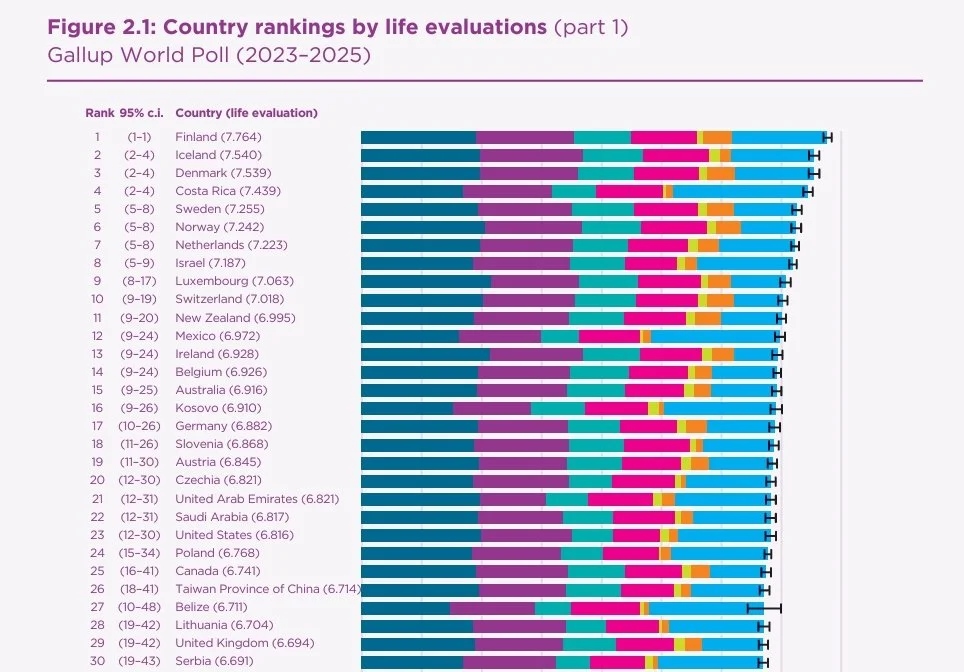
The Nordic countries retain the top spots in the world happiness rankings, Finland is No.1 (again!), followed by Iceland then Denmark; Costa Rica has jumped to 4th place.
Young people’s happiness is falling in English-speaking countries. In places like North America and Western Europe, young people are significantly less happy than 15 years ago, unlike most of the world, where youth wellbeing has improved.
Heavy social media use is linked to lower wellbeing. On average, those who use social media for longer periods report lower life satisfaction than light users.
Not all screen time is equal. Activities like messaging, learning, and creating content are linked to higher wellbeing, while passive scrolling, gaming, and “browsing for fun” are linked to lower wellbeing.
How social media is designed really matters. Platforms that encourage connection tend to support happiness, while those driven by algorithms, influencers, and comparison tend to harm it.
Many people feel ‘trapped’ using social media. A lot of users say they’d actually prefer social media didn’t exist, but they keep using it because everyone else does.
Connection in real life matters far more. Feeling a sense of belonging (e.g. at school or in community) has a much bigger impact on happiness than reducing social media use alone.
The research is clear - we need to prioritise connection and community over scrolling and disconnection.
Top 30 Happiest Countries
2026 QUOTES
“Social media promised us connection, but for many, it has brought comparison and anxiety instead. The latest research is clear: happiness comes from actively building real human connections and finding meaning in our lives. Rather than influencers and audiences, what we actually need most is real community.”
“When it comes to happiness, building what is good in life is more important than finding and fixing what is bad. Both need doing, now more than ever.”
“Every year, Gallup asks people across more than 140 countries to evaluate their lives. Most of the world’s young people are happier today than they were 20 years ago, and that’s a trend that deserves attention.”
“The global evidence makes clear that the links between social media use and our wellbeing heavily depend on what platforms we’re using, who’s using them and how, as well as for how long. Heavy usage is associated with much lower wellbeing, but those deliberately off social media also appear to be missing out on some positive effects.
Beyond the complexity, it is clear that we should look as much as possible to put the ‘social’ back into social media.”
“The digital age is reshaping the social and emotional foundations of wellbeing in Europe. The effects are neither uniform nor inevitable: they depend on who you are, the social world you inhabit, and the digital environment surrounding you. Understanding these interactions is essential for developing policies that support wellbeing in an increasingly online society.”
ABOUT THE REPORT
The World Happiness Report (WHR) is a partnership of Gallup, the Oxford Wellbeing Research Centre, the UN Sustainable Development Solutions Network and the WHR’s Editorial Board. The report is published by the Wellbeing Research Centre at the University of Oxford and produced under the editorial control of the WHR Editorial Board.
Powered by data from the Gallup World Poll, the World Happiness Report is the world’s foremost publication on global happiness: an annual publication which provides valuable, interdisciplinary insights into the wellbeing and happiness of people across the globe.
In addition to the rankings of the world’s happiest countries, the report includes original research and curated submissions from experts at the forefront of wellbeing science.
Find out more about this year's report at http://worldhappiness.report